
9 min read
TL;DR
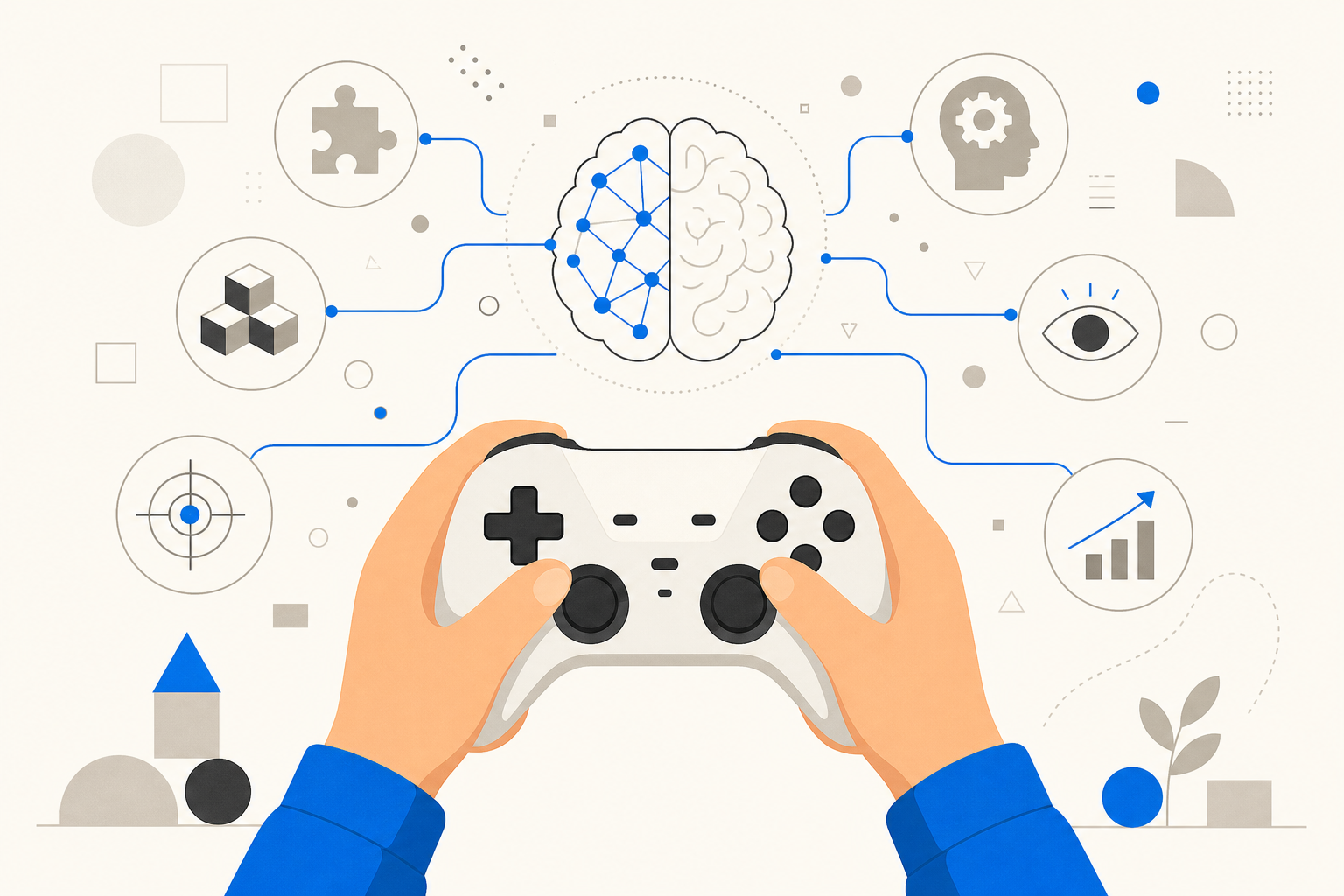
Video games and kids’ brain development are more connected than most parents realize. A landmark NIH-funded study of nearly 2,000 children found that those who gamed regularly outperformed non-gamers on tasks measuring impulse control and working memory – with brain scans to match. That’s just the start. From spatial reasoning to reading ability, research has consistently linked moderate, intentional gaming to genuine cognitive gains. The catch? Game type, daily duration, and the child’s age all matter. Here are 10 science-backed reasons why the right kind of gaming is actually good for developing brains – and what parents need to know to get the most out of it.
1. Better Impulse Control – Backed by a Major NIH Study
The biggest piece of evidence in favor of video games and kids’ brain development comes from the Adolescent Brain Cognitive Development (ABCD) Study, one of the largest long-term studies of brain development ever conducted in the US. Researchers at the University of Vermont analyzed data from nearly 2,000 children aged 9–10 and published their findings in JAMA Network Open.
The result: kids who played 3+ hours of video games daily performed significantly better on tasks measuring impulse control compared to children who didn’t game at all. Brain scans backed this up – the gaming group showed higher activity in regions linked to attention and cognitive control.
Lead researcher Bader Chaarani, Ph.D., noted: “While we cannot say whether playing video games regularly caused superior neurocognitive performance, it is an encouraging finding, and one that we must continue to investigate.”
Impulse control is a core life skill – it’s linked to academic performance, emotional regulation, and even long-term career success. The fact that gaming appears to support it, not erode it, is a meaningful finding.
2. Stronger Working Memory
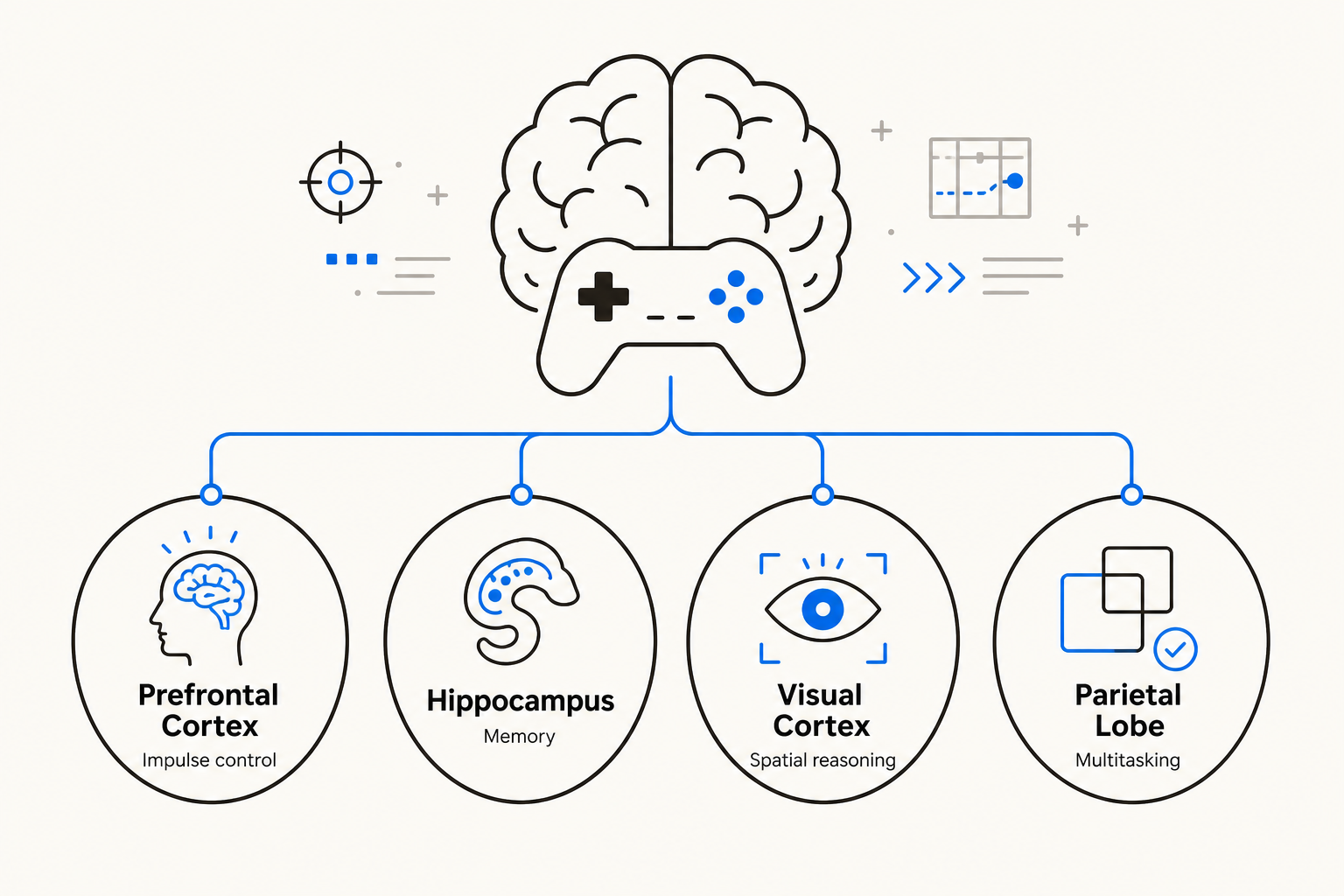
Working memory is the mental workspace where kids hold and manipulate information in the moment – following multi-step instructions, solving math problems, understanding what they just read. It’s foundational to learning.
The same JAMA Network Open study found that children who gamed regularly were faster and more accurate on working memory tasks, not just impulse control. Brain imaging showed their neural activity patterns were more efficient – less effort for the same cognitive output, which is a hallmark of a well-trained brain.
This isn’t entirely surprising. Most games constantly demand that players track multiple variables simultaneously: enemy positions, resource counts, mission objectives, teammate states. That’s working memory being exercised in real time, repeatedly, under pressure.
3. Sharper Attention and the Ability to Filter Distractions
One of the most replicated findings in gaming research is that action games train attention. Specifically, they improve the ability to:
- Track multiple moving objects at once
- Detect targets against noisy visual backgrounds
- Sustain focus over extended periods
- Rapidly shift attention between competing stimuli
Research synthesized in Frontiers for Young Minds (2023) found these effects are consistent across multiple studies. The mechanism makes intuitive sense – action games punish inattention immediately and reward sharp focus with in-game success, creating a powerful feedback loop that the brain is wired to respond to.
For children who struggle to maintain focus in low-stimulation environments like classrooms, action games may actually be building the same attentional hardware they need.
4. Spatial Reasoning – The Skill That Predicts STEM Success
Spatial reasoning – the ability to mentally rotate 3D objects, visualize how parts fit together, and understand how objects relate in space – is one of the strongest predictors of success in STEM fields. It’s also one of the clearest areas where video games show measurable benefit.
Research cited by Parenting Science found:
- Experienced gamers demonstrated superior ability to mentally rotate objects compared to non-gamers
- Inexperienced players who were trained with action games improved their spatial rotation abilities
This isn’t just useful for engineering. Spatial reasoning underpins reading maps, understanding geometry, assembling furniture, and dozens of everyday tasks. Games that require players to navigate 3D environments, aim in space, and solve spatial puzzles are giving kids direct practice on this skill.
5. Faster Information Processing Speed
Speed matters in cognitive performance. The ability to take in information, process it, and respond accurately – quickly – is a core component of fluid intelligence.
Action game players consistently outperform non-gamers on processing speed tasks. The Frontiers for Young Minds research found this effect holds across multiple studies: fast-paced games appear to calibrate the brain to expect and process rapid visual input, which transfers to faster performance on unrelated cognitive tasks outside the game.
For kids, faster processing speed means faster reading, quicker mental arithmetic, and sharper real-time decision-making.
6. Multitasking and Task-Switching Ability
Modern games – especially real-time strategy games, MOBAs, and action-adventure titles – require players to manage multiple priorities simultaneously. Check the map, manage resources, respond to threats, communicate with teammates, and execute a plan. All at once.
This demands genuine cognitive flexibility: the ability to switch between tasks without losing context. Research in the Frontiers synthesis found that video game players show improved performance on task-switching tests compared to non-gamers, likely because effective gaming requires building this capacity.
Task-switching is essential in real life. It’s what lets a student shift between reading, note-taking, and listening during a lecture – or an adult manage competing work priorities – without losing the thread on any of them.
7. Problem-Solving and Critical Thinking
Puzzle games, strategy games, and open-world exploration games place problem-solving at their core. Players face novel challenges, test hypotheses, fail, adjust, and try again – iteratively. That’s the scientific method, in game form.
Games like Portal 2 require players to understand and manipulate physics to progress. Games like Starcraft demand strategic resource allocation and adaptive planning against unpredictable opponents. The Frontiers for Young Minds synthesis notes that while evidence is less consistent than for action games, these game types show genuine promise for developing problem-solving skills.
The real advantage here may be the low-stakes failure environment. Games let kids fail, learn, and iterate without real-world consequences – which is precisely the condition under which humans learn most effectively.
8. Brain Plasticity – Games Literally Change the Brain
The developing brain is remarkably plastic – it physically changes based on experience, forming and strengthening neural connections in response to repeated activity. This is why musicians develop enhanced auditory processing, and athletes develop refined motor pathways. Video games work the same way.
As the Frontiers for Young Minds research explains, playing video games activates brain plasticity mechanisms: repetitive practice creates neural pathways between brain regions, and those pathways become more efficient over time. The brain scans in the ABCD Study showed exactly this – gaming children’s brains processed cognitive tasks with less neural effort, suggesting the underlying circuits had been trained to work more efficiently.
This is the same mechanism that underlies all skill acquisition. Gaming is, in a real sense, exercise for the brain.
9. Reading Ability – Unexpected Help for Dyslexic Kids
This one surprises most parents: action video games have been shown to improve reading ability in children with dyslexia.
The research, from studies by Franceschini et al. (2013) and Bavelier et al. (2013), found that the visual attention training inherent in action games – tracking fast-moving targets, filtering distractions, rapidly processing spatial information – directly strengthens the attentional systems that support reading fluency.
Dyslexia is partly a visual attention disorder, not just a phonological one. The rapid visual demands of action games appear to train exactly the systems that struggle in dyslexic readers, with measurable effects on reading speed and accuracy.
This is a case where a cognitive benefit of gaming showed up somewhere researchers didn’t expect to find it – which tends to mean the underlying mechanism is real.
10. Empathy and Cooperation From Prosocial Games
Not all cognitive development is purely computational. Empathy, cooperation, and social problem-solving are core developmental outcomes that matter as much as working memory or spatial reasoning.
Research has found that prosocial games – games that reward helping, cooperation, and team outcomes – measurably increase helping behavior in real-world settings. Games that put players in the shoes of diverse characters, navigate complex social situations, or require genuine team coordination appear to build the social-cognitive muscles that underlie empathy and cooperation.
The effect isn’t enormous, but it’s consistent: what you practice in games, you get better at – including how you relate to others.
The Important Caveats
The science is genuinely encouraging – but it comes with conditions that matter.
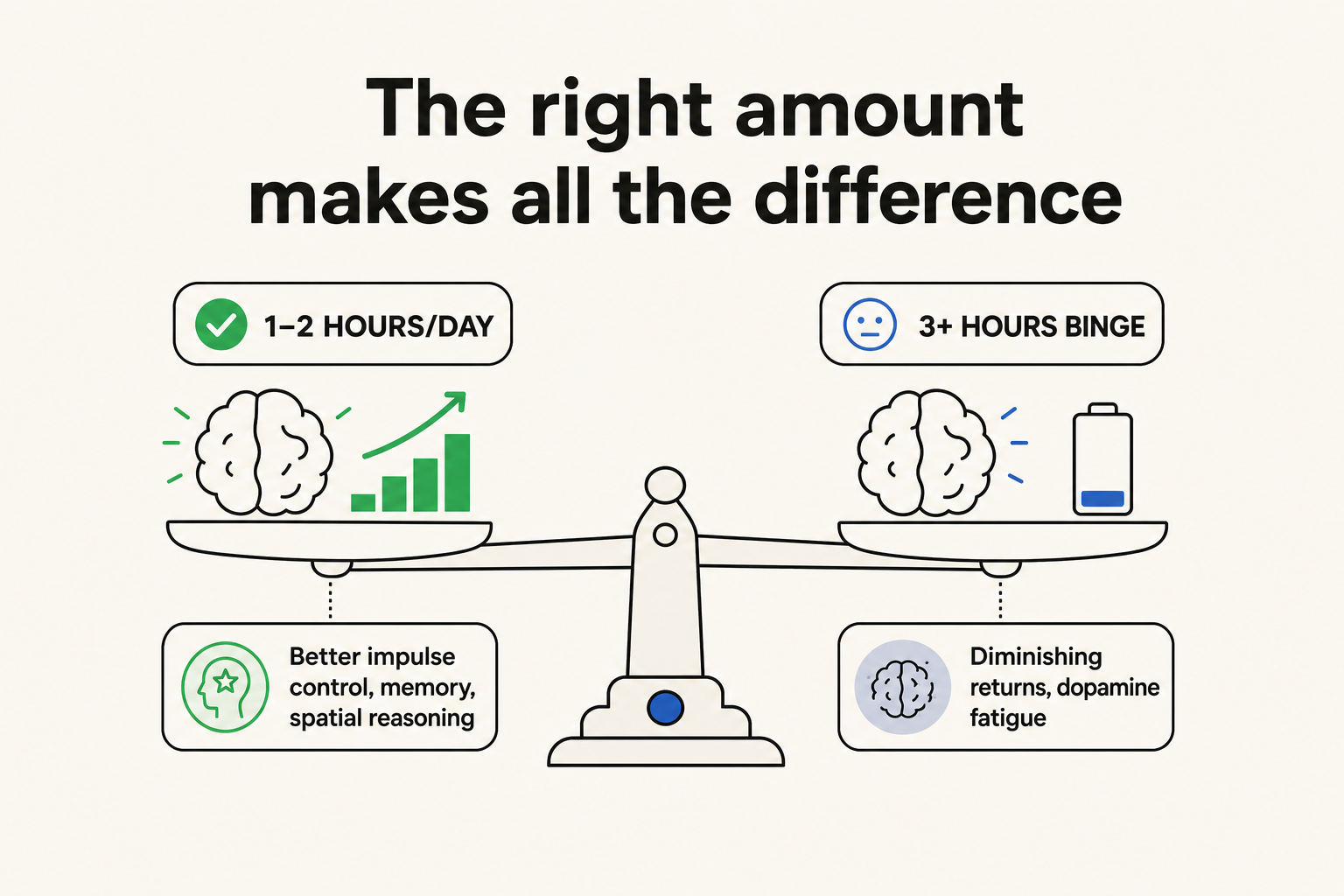
Duration is critical. Most research labs cap gaming at 1 hour per day to reliably see cognitive benefits. The American Academy of Pediatrics recommends no more than 1–2 hours daily for school-age children. Brain imaging studies found that college students gaming 10+ hours daily had measurably less gray matter than those playing under 2 hours daily. More is not better.
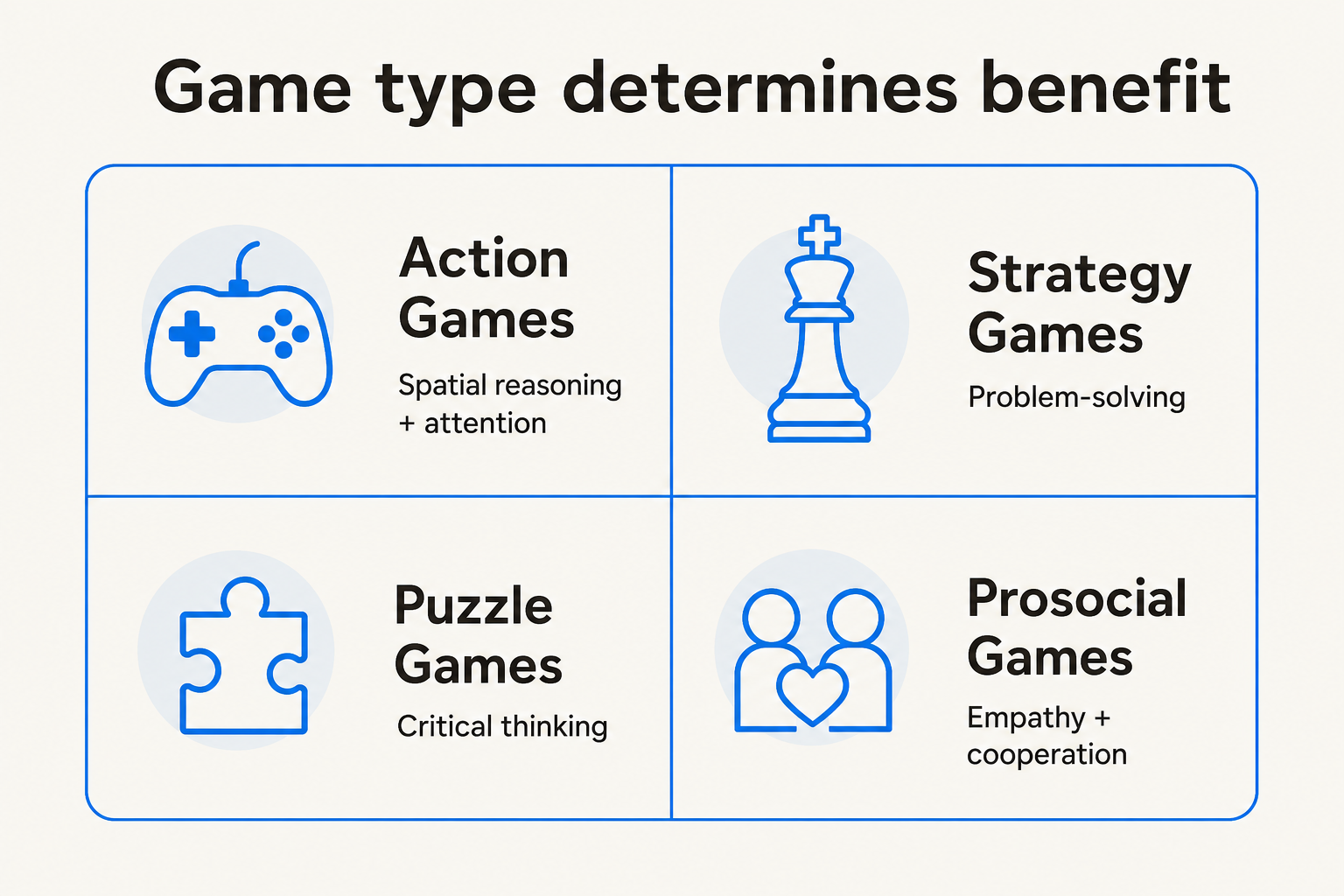
Game type matters enormously. The cognitive benefits above come from specific game categories – action games for perception and attention, puzzle/strategy games for problem-solving, prosocial games for empathy. Violent games show a different pattern: research found that even 30 minutes of violent gaming lowered activity in the prefrontal brain regions responsible for impulse control. Game selection isn’t incidental to brain development – it determines which direction things go.
The prefrontal cortex is still forming. The brain’s judgment and impulse-control center doesn’t fully develop until age 25–30. This makes adolescents genuinely more susceptible to gaming’s effects – both positive and negative – than adults.
Correlation isn’t causation. The ABCD Study’s own researchers noted that children who are already cognitively sharp may self-select into gaming. The longitudinal phase of the study will help establish whether gaming causes cognitive benefits, or simply attracts children who already have them.
What This Means for Parents
The research doesn’t say “let kids game freely.” It says the right games, in reasonable amounts, build real cognitive skills. That’s a meaningfully different conclusion from either “games are harmless” or “games rot brains.”
The practical takeaways:
- Keep it to 1–2 hours a day. Benefits plateau and risks increase beyond that.
- Choose games with intention. Action, puzzle, and prosocial games have different effects. Violent games consistently show negative effects on impulse control.
- Distributed play beats binge sessions. Daily moderate gaming is more beneficial than three-hour weekend marathons.
- Age matters. Younger children’s brains are more plastic – and more vulnerable. Age-appropriate game ratings exist for a reason.
Gaming isn’t the enemy of childhood development. Unguided, unlimited gaming is. The science is clear enough to give parents both the confidence to let kids play and the framework to do it well.
Sources: NIH/ABCD Study – JAMA Network Open · Frontiers for Young Minds · Brain and Life · Parenting Science · NIH News Release