
Are video games good for kids? Science says it depends on the game, the hours, and parental involvement. Here’s what parents actually need to know.
June 9, 2026 · 11 min read
TL;DR
Are video games good for kids? The honest answer is: it depends on which games, how long, and how involved you are as a parent. Strategy and puzzle games measurably improve problem-solving, spatial reasoning, and executive function. Cooperative multiplayer games build teamwork and reduce aggression compared to competitive-only play. But casual mobile games offer almost no cognitive benefit and are deliberately engineered to maximize time spent. The risk isn’t gaming itself — it’s gaming that displaces sleep, physical activity, and face-to-face connection. One to two hours of the right games, with parental involvement, looks genuinely beneficial for most school-age kids. Three hours of whatever autoplay serves next? Less so.
The question most parents are actually asking
When a parent asks “are video games good for kids?” they’re usually asking something more specific: Is it okay that my child would rather play Minecraft than go outside? Am I doing harm by letting this happen? How much is too much?
Those are fair questions, and the science has gotten sharper on them over the past decade. The old debate — games bad, get outside — has given way to something more useful: a framework for which games, at what ages, and under what conditions. Researchers at the American Academy of Pediatrics, the American Psychological Association, and child development programs at places like Iowa State University have spent years working out the details. Here’s what they’ve found.
What the research actually shows
The shift in scientific consensus over the last 15 years is worth naming. In the early 2000s, video game research was dominated by studies on violence and aggression. Today, the conversation is far more nuanced: spatial reasoning and problem-solving benefits are well-documented, social skill development through cooperative play has been replicated, and researchers are now asking the harder questions — about game design, monetization, and the tradeoff between time spent gaming versus time spent on sleep and physical activity.
The bottom line from pediatric and psychological research: video games are a tool. Like most tools, their value is determined by how they’re used.
The cognitive benefits that are actually backed by research
Not all claimed benefits survive scrutiny. These ones do.
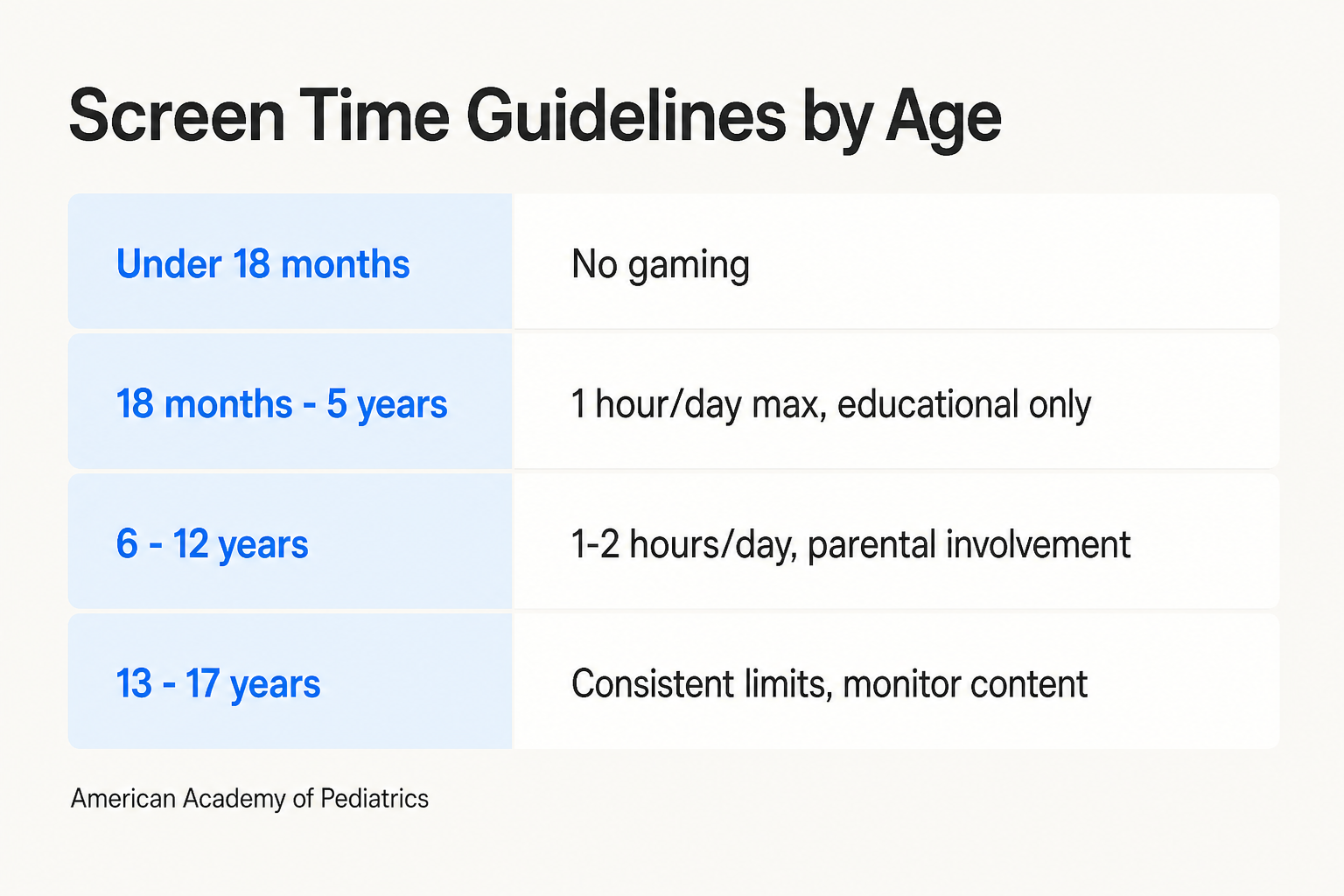
Problem-solving and strategic thinking
Studies on strategy games consistently show that children who play titles requiring planning and multi-step decision-making demonstrate improved problem-solving abilities. The cognitive demands of games like Civilization, Fire Emblem, or even Plants vs. Zombies — where you’re managing resources, anticipating opponent moves, and thinking several steps ahead — appear to transfer to academic performance, particularly in mathematics. The effect size is comparable to chess training, which has its own well-documented academic benefits.
Spatial reasoning
This is probably the most replicated finding in video game research. Research from the Rochester Institute of Technology and multiple independent studies show that action games and 3D puzzle games improve visual-spatial skills — the ability to mentally rotate objects, navigate three-dimensional environments, and understand spatial relationships. These skills correlate with performance in STEM fields. The effect isn’t small: some studies show measurable improvements after relatively brief periods of play.
Attention and sustained concentration
There’s a common parent worry that games destroy attention spans. The research tells a different story. Games that reward focus and penalize distraction — which is most good games — appear to train children’s ability to sustain concentration on complex tasks. The key word is “complex”: games that require active strategic thinking have different effects than passive TV watching, and that distinction matters.
Hand-eye coordination and reaction time
Action games produce measurable improvements in hand-eye coordination and reaction time comparable to surgical training programs. Laparoscopic surgeons who played video games made fewer errors and completed procedures faster in several studies. For kids, this translates to motor control, sports performance, and general manual dexterity.
“The data on spatial reasoning is some of the most consistent in the field. We’re not talking about a marginal effect — action and puzzle games produce improvements that transfer outside the game environment.” — Research synthesis from Psychological Science
Social development: more complex than you’d think
Parents often frame online gaming as antisocial. The research is more interesting than that.
Cooperative multiplayer games have been shown to reduce aggression compared to competitive-only play. When children work together toward shared goals — building a Minecraft world, defending a base in a tower defense game, completing a cooperative puzzle — they practice teamwork, communication, negotiation, and conflict resolution in real time. For socially anxious, neurodivergent, or geographically isolated kids, online gaming communities have been particularly valuable in building friendships and a sense of belonging.
The caveat is real, though. The same online multiplayer environments that build social skills can expose kids to toxic behavior, cyberbullying, and — rarely but seriously — predatory contact from strangers. The game environment matters enormously: a closed Minecraft server with known friends is categorically different from unmoderated open lobbies in competitive shooters. Parental involvement in choosing which games and which servers shapes the social outcome more than the category of gaming itself.
The risks that actually warrant concern
Let’s be specific about what the risks are and aren’t, because vague worry is less useful than accurate worry.
Sleep displacement: the most consistent harm
The WHO’s 2019 physical activity guidelines identify sedentary screen time as competing directly with sleep — and the AAP is clear that children need 8-10 hours of sleep nightly for healthy development. When gaming runs into late evening hours, the blue light and mental stimulation of games actively disrupts sleep quality, not just duration. Sleep-disrupted kids show worse academic performance, emotional regulation, and immune function. The solution here is structural, not gaming-specific: keep screens out of bedrooms and set a consistent gaming cutoff, not just a daily time limit.
Addictive design: the deliberate kind
Many commercial games — particularly mobile titles and games with live service models — are designed by teams whose job is specifically to maximize time spent in-app. Loot boxes, battle passes, variable reward schedules, and daily login bonuses exploit the same psychological vulnerabilities as slot machines. A small but real percentage of children develop gaming patterns that meet clinical criteria for behavioral addiction: prioritizing gaming over sleep, meals, and schoolwork; withdrawal symptoms when restricted; deception about time spent. This is not a character flaw — it’s an intended design outcome that parents need to specifically watch for.
Physical inactivity: the compounding problem
Gaming’s biggest health cost is opportunity cost. Time spent gaming is time not spent running, swimming, or playing outside. WHO guidelines call for 60 minutes of moderate-to-vigorous physical activity daily for school-age children, and sedentary behavior directly undermines this. The cognitive benefits of gaming get partly or fully offset when gaming comes at the expense of physical activity, which has its own strong cognitive and emotional development benefits.
Violent content: smaller risk than assumed
This is the area where parental anxiety and research evidence are most misaligned. Meta-analyses published in the APA’s Psychological Bulletin consistently find that the effect of violent game exposure on aggressive behavior in children is small — effect sizes that a well-designed family environment easily overrides. A child with stable caregivers, healthy emotional regulation, and no history of trauma is very unlikely to become more aggressive from playing a rated-M game. The risk rises for younger children (under 8) and for kids already dealing with family conflict or trauma. The practical takeaway: ESRB ratings exist for a reason, and a 7-year-old probably shouldn’t play Grand Theft Auto — but a well-adjusted 14-year-old playing Call of Duty isn’t a crisis waiting to happen.
Game types: not all games are the same
This is the most practically useful distinction parents can make. Genre predicts benefit and risk more reliably than any other factor.
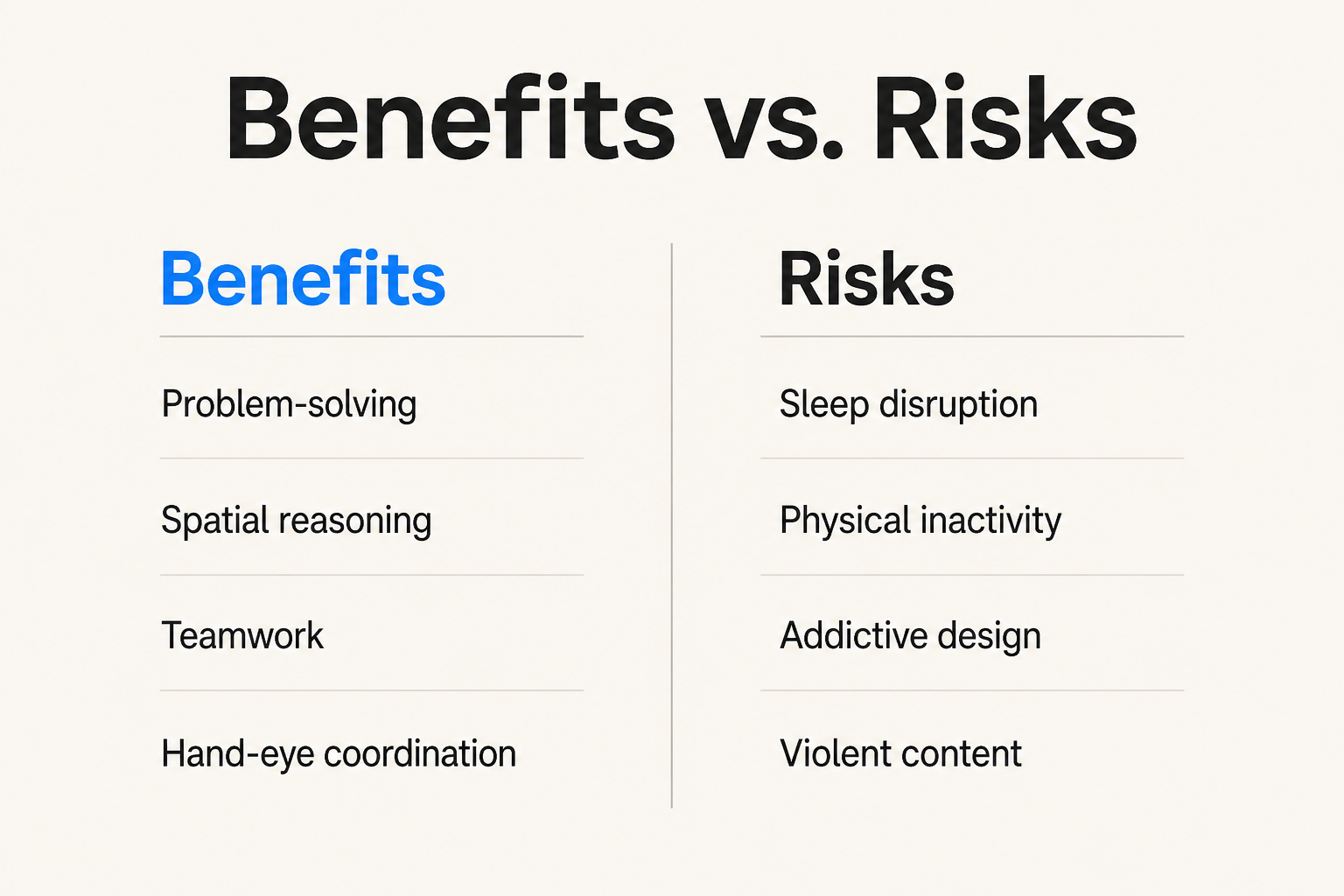
Strategy games (Civilization, Fire Emblem, Plants vs. Zombies, Into the Breach) deliver the strongest and most consistent academic benefits. Research from Iowa State University places the cognitive effects on par with chess training — which means real improvements in working memory, planning, and abstract thinking that transfer to school performance. Best suited for ages 8 and up.
Puzzle games (Portal, Tetris, The Witness, Monument Valley) build spatial reasoning and logical thinking with very clean research backing. Low violence, no exploitative monetization, and genuinely transferable cognitive benefits. Well-suited starting from age 5 for simpler titles.
Educational games (Khan Academy Kids, Prodigy Math, Duolingo, Kerbal Space Program) vary enormously in quality. Well-designed titles with clear learning objectives aligned to developmental stage show modest positive effects on reading, math, and language skills. Generic “edutainment” with learning as window dressing delivers almost nothing. The APA’s research on educational games specifically flags that design quality is the difference between benefit and waste.
Action games (platformers, rhythm games, sports games, mild combat games) deliver the strongest evidence for spatial reasoning and hand-eye coordination improvements. The concern scales with content intensity: age-6-appropriate platformers like Super Mario Odyssey differ enormously from age-17-targeted shooters. Content matters as much as genre here.
Cooperative multiplayer games (Minecraft, Animal Crossing, Stardew Valley, Among Us) support teamwork, communication, and social skill-building when played with known peers. The social benefits are real, and cooperative play specifically reduces aggression compared to competitive-only titles. The main risk is the online safety dimension, which parental supervision can largely manage.
Narrative-heavy games (Undertale, the Ace Attorney series, Life is Strange for older teens) can enhance reading comprehension, vocabulary, and moral reasoning through story-driven choices. Often underrated by parents who see “video game” and assume low literary value.
Casual and mobile games (Candy Crush, idle games, most free-to-play mobile titles) offer minimal cognitive benefit and are the most likely to involve exploitative design. Variable reward schedules, constant monetization prompts, and dopamine loops optimized for engagement time over experience quality — these games are the ones most likely to trigger problematic gaming patterns. They’re also the ones most readily available on phones without parental setup. Worth the most scrutiny.
Age-by-age: what’s appropriate when
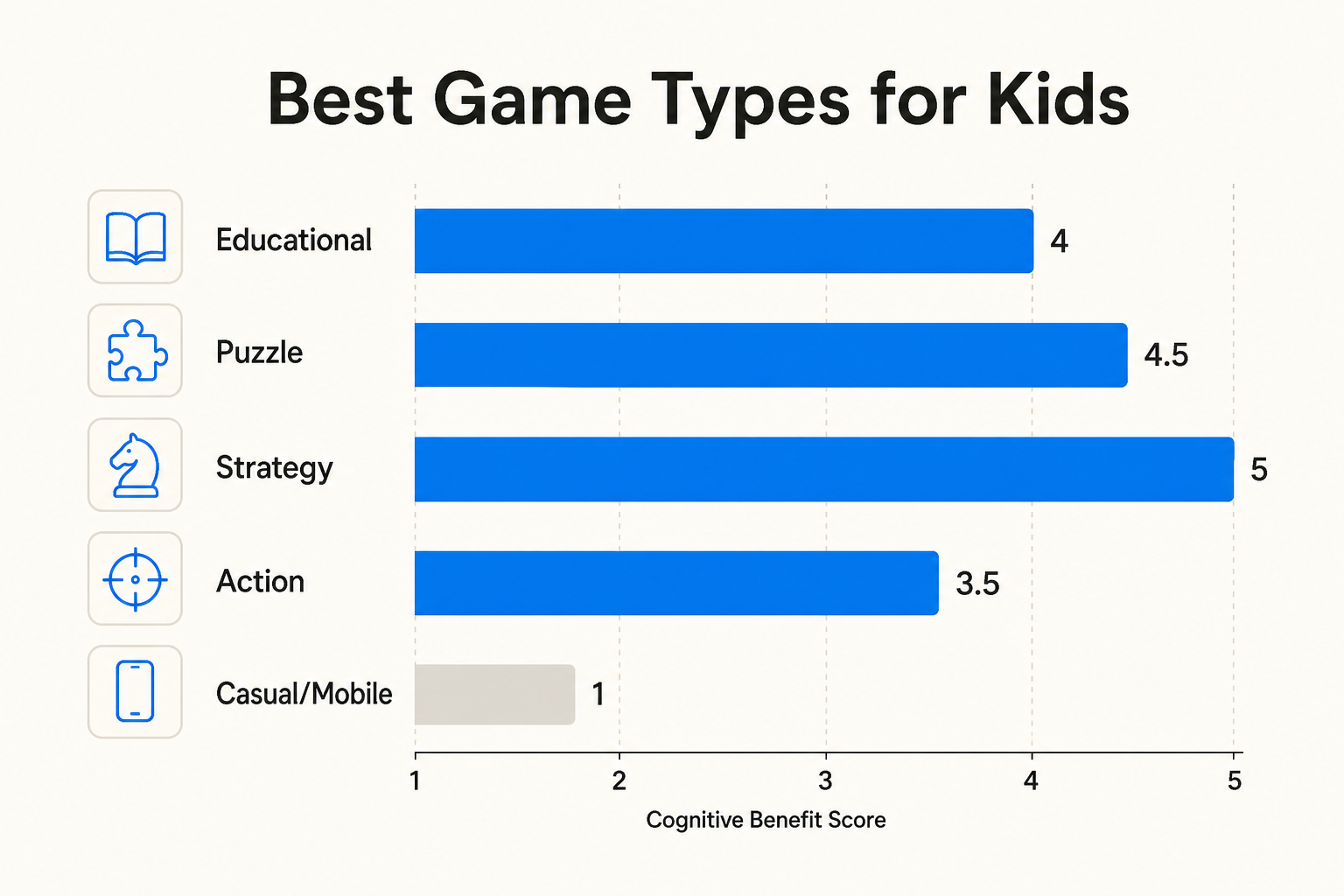
Under 18 months: The AAP recommends no gaming or screen time at this age, except video chatting. Infants learn through direct physical interaction with caregivers, not screens.
18 months to 5 years: If you’re going to introduce games, the AAP recommends high-quality educational content only, co-viewed with a parent, capped at 1 hour per day. Simple, non-violent, educational — most mainstream games don’t qualify. Khan Academy Kids and similar purpose-built apps are worth considering; most of what’s on tablet app stores isn’t.
6 to 12 years: This is the window where gaming’s cognitive benefits are most accessible and the risks most manageable. Strategy and puzzle games are a great introduction. One to two hours of quality content daily, with parental co-play or at minimum genuine conversation about what they’re playing, is where most experts land. The AAP doesn’t set a rigid hour ceiling for this age group — instead emphasizing that sleep, physical activity, and social time come first. If those are protected, gaming time is a reasonable secondary priority.
13 to 17 years: Teens can engage with more complex games and are better equipped to handle nuanced content. The risk profile shifts here: older teens are more susceptible to the social dynamics of online competitive gaming (including toxic behavior and its effects on mental health) and more likely to self-regulate gaming into late-night hours. Keeping devices out of bedrooms and maintaining an open, non-confrontational conversation about what they’re playing matters more than a fixed hour limit.
Practical ways to make gaming work for your family
Play the game first, or at least alongside your child. Common Sense Media reviews games in detail — content, age-appropriateness, monetization models — and is genuinely useful for pre-screening. But nothing replaces actually seeing how a game works and what it’s asking of your child.
Separate time limits from bedroom rules. The most evidence-backed practice isn’t a specific daily hour limit — it’s keeping screens out of bedrooms. Sleep disruption is the most consistent measured harm from gaming, and a device-free bedroom solves it structurally rather than through daily negotiation.
Watch for warning signs of addictive patterns, not just hours logged. The hours aren’t the only signal. A child who logs two hours and then happily goes to dinner and does homework is in a different situation than one who can’t stop without a fight and lies about how long they played. The AAP outlines behavioral warning signs that suggest a pediatric consultation is worth considering.
Use co-play as an investment, not a chore. Parents who play games alongside their children consistently report that it amplifies both the enjoyment and the learning. You understand what your child is experiencing, you can talk about strategies and stories naturally, and the child gets positive parental attention woven into gaming time. The research on this is clear: parental involvement is one of the strongest predictors of whether gaming outcomes skew positive or negative.
Apply ESRB ratings as a floor, not a ceiling. A game rated E (everyone) is appropriate for all ages. A game rated M (mature, 17+) is not appropriate for an 8-year-old regardless of what their friends are playing. Ratings are inconsistently enforced by retailers, which means parents need to do the filtering.
“We’ve seen firsthand in our research that kids benefit more from gaming when parents treat it as a shared activity rather than a babysitter. Co-play and conversation about game content are protective factors that change the outcome.” — From Iowa State University’s Media Research Lab
The verdict
Are video games good for kids? Strategy games, puzzle games, and well-designed cooperative multiplayers: yes, with real cognitive and social benefits backed by solid research. Casual mobile games, competitive online shooters for under-10s, and anything with loot boxes marketed to children: not particularly — and the addictive design patterns in those games warrant specific parental attention.
The most useful frame isn’t “are games good or bad?” but “does my child’s gaming fit within a healthy day?” If it does — if sleep, physical activity, homework, and offline social time are all intact — the games themselves are probably doing more good than harm. If it doesn’t, the problem is the overall balance, and gaming is more symptom than cause.
One thing the research is clear on: the parents who approach gaming as a conversation to be had rather than a battle to be won consistently end up with better outcomes. Know what your kid is playing, play it with them occasionally, and treat gaming as one part of a full life rather than a threat to one.
Frequently Asked Questions
Are video games good for kids’ brain development?
Certain types of video games can support brain development. Research on spatial reasoning shows action and puzzle games improve visual-spatial skills that transfer to math and engineering. Strategy games build executive function comparable to chess training. The key factors are game type, session length, and age-appropriateness — not gaming in general.
How many hours of video games per day is healthy for kids?
The American Academy of Pediatrics recommends no gaming for children under 18 months, a maximum of 1 hour per day of high-quality content for ages 18 months to 5 years, and consistent (not necessarily minimal) limits for ages 6 and up. For school-age children, 1-2 hours of quality gaming daily is a widely used benchmark, as long as sleep (8-10 hours nightly) and 60 minutes of physical activity are preserved.
Do violent video games make kids more aggressive?
Research from the APA’s Psychological Bulletin finds that the effect of violent games on aggression is small and heavily dependent on individual factors — age, personality, family environment, and prior trauma. A child with a stable home and healthy emotional regulation is very unlikely to become more aggressive from game violence. The risk is real but substantially weaker than other environmental factors like family conflict.
What video games are best for kids?
Strategy games (like Civilization or Plants vs. Zombies), puzzle games (like Portal or Tetris), and well-designed educational games (like Khan Academy Kids or Prodigy Math) deliver the most consistent cognitive benefits. Cooperative multiplayer games like Minecraft and Animal Crossing also support social skills. Casual mobile games (Candy Crush, idle games) offer the least benefit and carry the highest risk of addictive design patterns.
How do I know if my child has a gaming addiction?
Warning signs include gaming taking priority over homework, sleep, and meals; irritability or anger when gaming is restricted; deception about how much time was spent gaming; and withdrawal from offline friendships. The American Academy of Pediatrics recommends consulting a pediatrician if these behaviors persist for more than a few weeks, as a small percentage of children do develop clinically significant gaming disorder.