
The best free online puzzle and logic games ranked – from Sudoku to logic grids, chess puzzles, and more. No download needed, all playable today.
July 6, 2026 · 12 min read
TL;DR
The best free online puzzle games right now: Sudoku.com for daily logic warmups, 2048 for quick strategic thinking, Puzzle Baron if you want genuine deductive reasoning (25,000+ puzzles, all free), and Simon Tatham’s Puzzle Collection for sheer variety with zero monetization. One thing worth saying upfront: the “keep your brain sharp” pitch is partly marketing. Cognitive science is pretty clear that task-specific gains are real but transfer to general intelligence is not well-supported. Play these because they’re genuinely good fun – that’s the actual case for them.
There’s no shortage of claims that puzzle games will rewire your brain, boost your IQ, and protect you from cognitive decline. Most of that is marketing copy. What’s actually true is narrower but still worthwhile: regular engagement with logic puzzles builds specific skills – deductive reasoning, pattern recognition, working memory for the task at hand – and they’re genuinely enjoyable in a way that most “brain training apps” are not.
The games below are the ones we’d recommend if a friend asked. They’re all free (or free to start), all playable in a browser without downloading anything, and all legitimately good at what they claim to do. We’ve tried them, read the communities that play them obsessively, and cut anything that leads with brain-health promises and delivers a paywall.
How to pick the right puzzle game for you
Before diving into the list, a quick framing note: not all online puzzle games are the same, and the right pick depends on what kind of engagement you’re after.
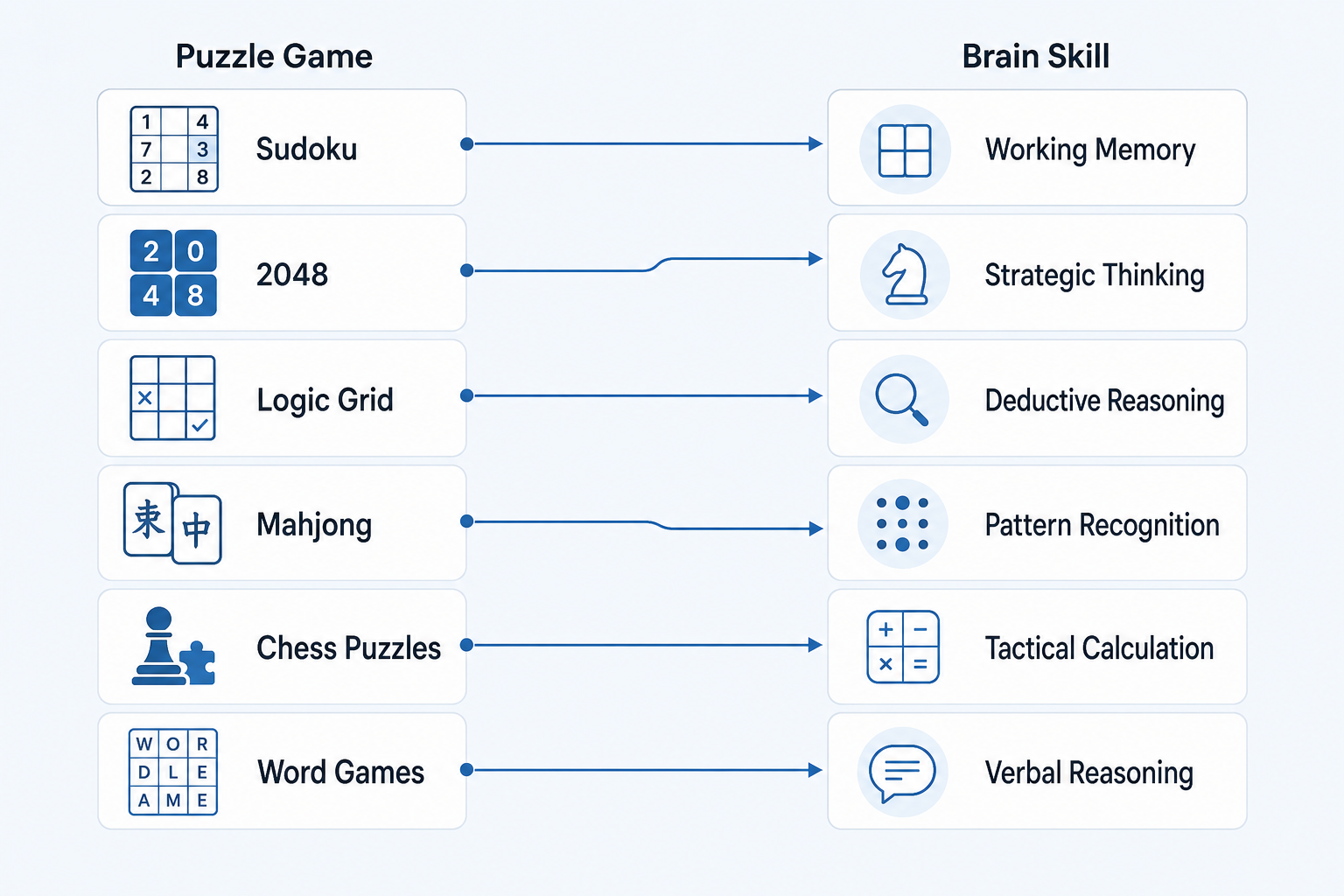
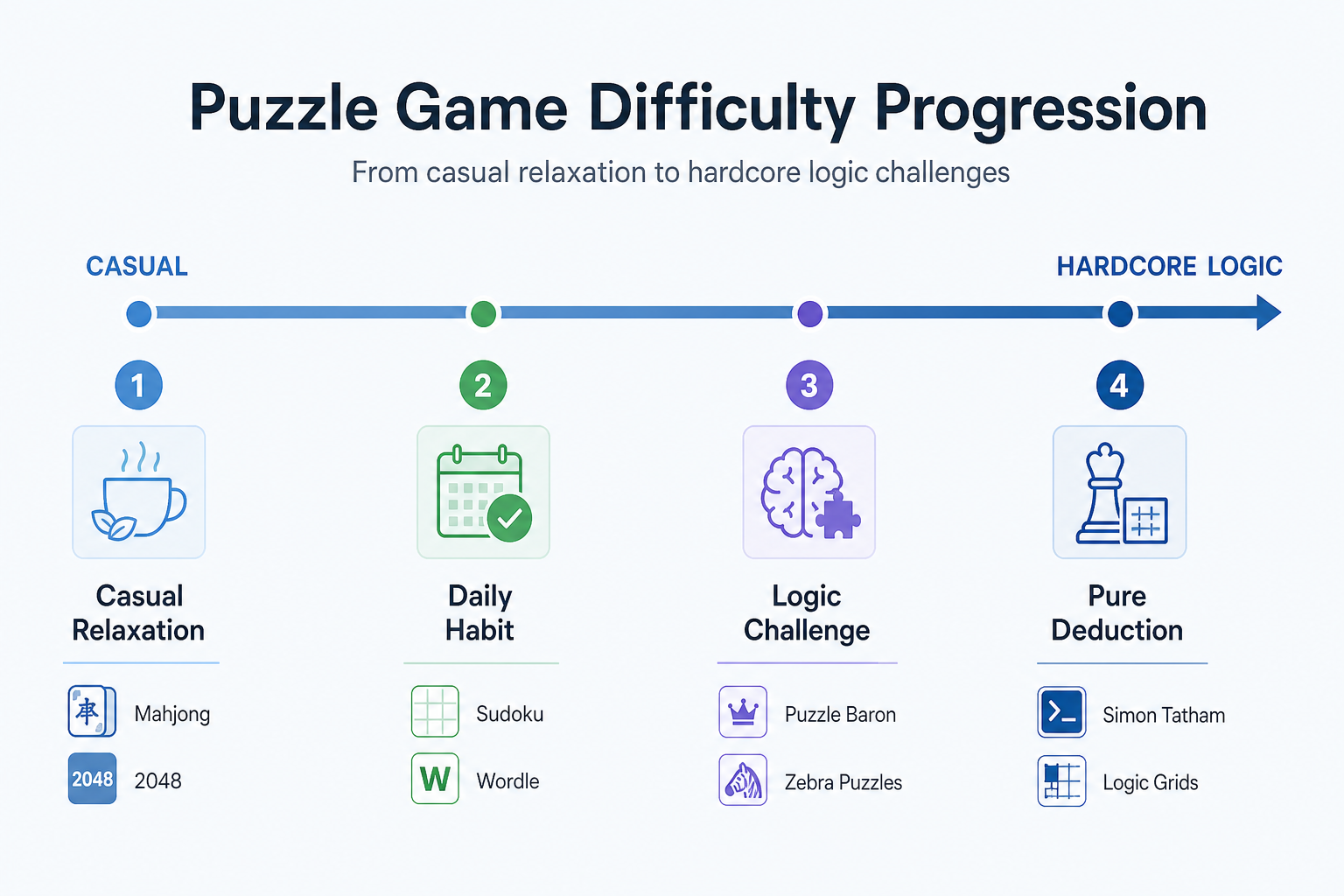
If you want calm, meditative play – Sudoku and Mahjong Solitaire are your lanes. Both have a gentle, repetitive quality that feels restorative rather than demanding.
If you want genuine deductive challenge – Logic grid puzzles (Puzzle Baron, Zebra Puzzles) are what puzzle enthusiasts mean when they talk about “pure logic.” Every solution is reachable through deduction alone; no guessing required.
If you want something you can actually get better at over time – Chess puzzles are the standout here. Progress is measurable, and the tactical patterns you learn transfer directly to real chess games.
If you just want variety – Simon Tatham’s Puzzle Collection and BrainBashers both offer enough different puzzle types that you won’t hit the same thing twice for a long time.
1. Sudoku – the classic logic puzzle that earns its reputation
Best for: Daily brain warmups, anyone who wants a structured logic challenge with no learning curve.
Sudoku has been around long enough that it feels like furniture, which makes it easy to overlook. That would be a mistake. The 9×9 grid – fill each row, column, and 3×3 box with digits 1-9, no repeats – is a deceptively elegant constraint satisfaction problem, and the difficulty levels on Sudoku.com range from genuinely Easy to Extreme in a way that tracks actual complexity rather than just making the hints worse.
What makes Sudoku specifically good for logic skill-building is that every move is justified or it isn’t. There’s no luck, no guessing at higher difficulty levels – you’re either reading the constraints correctly or you’re not. Regular solvers develop strong pattern recognition for number distributions, which explains why the game feels almost automatic after a few months of daily play and genuinely hard when you first start.
Sudoku.com is the cleanest free web version available. It covers six difficulty levels including Killer Sudoku variants, daily tournament challenges, and progress tracking across sessions. The mobile app is equally clean. Free to play; optional $3.33/month premium removes ads.
Our take: If you’re going to pick one daily puzzle habit, Sudoku is the defensible choice. It takes 5-15 minutes depending on difficulty, it’s genuinely engaging, and the skill ceiling is much higher than it looks from the Easy tier.
2. 2048 – deceptively simple, strategically deep
Best for: Anyone who wants a quick strategic puzzle that fits in a five-minute break.
2048 is a 4×4 grid where you slide tiles to merge matching numbers – 2+2 becomes 4, 4+4 becomes 8, and so on, up toward the titular 2048 tile. Created by Gabriele Cirulli in 2014 and immediately viral, it’s been played hundreds of millions of times since. The rules take 30 seconds to learn. The strategy takes considerably longer to master.
The interesting strategic layer is board management: keeping your highest tile in a corner while building chains of merges isn’t obvious from the rules, but it’s what separates players who regularly hit 1024 from those who hit 512 and stall. The game trains forward planning specifically – you’re always thinking 2-3 moves out, not just the immediate merge.
The original play2048.co is free with no account required, and it includes undo functionality. The mobile ecosystem has dozens of variants if you want different grid sizes, but the original 4×4 is still the most satisfying.
Our take: Great for commutes and short breaks. The game ends when it ends – no time pressure – which makes it a natural fit for moments when you have a few minutes but not enough time for a full Sudoku session.
3. Mahjong Solitaire – pattern matching without the pressure
Best for: Stress relief, anyone who wants puzzle engagement without logic pressure.
Mahjong Solitaire (not the multiplayer Chinese game – the solitaire tile-matching variant) is one of the most-played browser games in the world, and it’s genuinely underrated as a puzzle experience. The setup: 144 tiles arranged in a pattern, paired by category, removed two at a time. Only “edge” tiles not covered by others can be selected.
The cognitive engagement is lighter than pure logic puzzles – there’s a satisfying visual scan-and-match rhythm rather than hard deduction – which is actually a feature, not a bug. It’s genuinely relaxing in a way that deep logic grids aren’t.
247Mahjong.com is the best free version, with 25+ layout variations (Classic, Pyramini, Butterfly, Great Wall, and more), seasonal themes, and a built-in hint system if you get stuck. The help button can show available pairs, which keeps sessions moving. Completely free, no account required.
Our take: Pick this when you want mental engagement without effort – before sleep, during a lunch break, or when you want something hands-off. It’s not the most cognitively demanding puzzle on this list, but it’s the most reliably relaxing.
4. Puzzle Baron logic grids – pure deductive reasoning
Best for: Logic puzzle purists who want constraint satisfaction without any randomness.
Logic grid puzzles are the format where you receive a set of categories (people, colors, jobs, ages) and a series of clues, then use a cross-reference grid to deduce which items go together. Every puzzle has exactly one solution reachable through logic alone – no guessing, no ambiguity.
Puzzle Baron has 25,000+ unique puzzles and is widely considered the best free logic grid site available. The puzzles range from 3-category beginner grids to 6-category expert puzzles that can run 30+ minutes. Monthly competitions with leaderboards, optional registration for progress tracking, and a genuinely active community forum make it more than just a puzzle dump.
“Found some Logic Grid Puzzle Websites [and Puzzle Baron] is a great one for people who want free logic grids without registrations” – r/puzzles community thread
The core gameplay loop: mark impossible pairs with X, confirmed pairs with O, work through clues until the grid fills in. The game enforces logic – if you mark a contradiction, it flags the error. This “no guessing” structure is what the serious puzzle community values most.
Free to play online or via iPad/Android apps. Optional premium removes ads and expands the solving area.
Our take: If you try one game from this list specifically for cognitive engagement, make it this one. Logic grid solving is the closest thing to formal deductive reasoning that you can do in a browser for free.
5. Chess.com puzzles – tactical thinking with measurable progress
Best for: Anyone who plays or wants to learn chess, or anyone who enjoys tactical pattern recognition with a skill rating system.
Chess puzzles work differently from other games on this list: you’re given a specific board position and must find the correct sequence of moves. There’s a single right answer (usually a tactic – fork, pin, discovered attack), and Chess.com’s puzzle system has over 500,000 positions organized by theme and difficulty.
What makes chess puzzles specifically interesting as a logic exercise is their combination of spatial reasoning (visualizing the board) and tactical calculation (computing 3-5 move sequences). The patterns are learnable – forks, skewers, back rank mates – and once you’ve seen a tactical motif enough times, you recognize it instantly. That pattern transfer is real and measurable.
Chess.com’s free tier gives access to the full puzzle library. Puzzle Rush (solve as many as possible in 3 or 5 minutes) and Puzzle Battle (competitive solving against another player) are among the most engaging modes. Premium unlocks analysis tools.
Our take: The measurable Elo-style puzzle rating is motivating in a way that “complete a Sudoku” isn’t – you can see actual improvement over time. If you’re interested in chess at all, this is the best free learning tool available.
6. Simon Tatham’s Portable Puzzle Collection – 30+ puzzle types, zero monetization
Best for: Variety seekers and anyone who wants pure puzzles with no paywalls, accounts, or ads.
Simon Tatham’s Portable Puzzle Collection is a free, open-source collection of 30+ logic puzzle games that runs entirely in the browser via JavaScript/WebAssembly. No ads. No account required. No premium tier. Just puzzles.
The range is remarkable: you get Sudoku variants (Solo), Minesweeper-style deduction (Mines), network connection puzzles (Net, Bridges), latin square variants (Keen, Towers, Unequal), sliding tile puzzles (Fifteen, Sixteen), and many others with no obvious analog. Each puzzle generates randomly, so you never run out. The interface is minimal – plain HTML, basic graphics – which some people find off-putting and others find refreshing.
“Simon Tatham’s Puzzle Collection – named repeatedly for ‘pure logic’ games with zero randomness, complete free access” – r/puzzlevideogames community recommendations
The collection is also downloadable for Windows and Linux if you want offline play. Created in 1998 and still actively maintained, it’s one of those quietly exceptional pieces of free software that the internet doesn’t talk about enough.
Our take: The go-to recommendation for anyone who’s burned out on the monetization in mainstream puzzle apps. The variety means there’s always something you haven’t tried. Start with Bridges or Net if Sudoku and Minesweeper feel too familiar.
7. Wordle and the NYT Games suite – daily word logic
Best for: Anyone who wants a daily puzzle ritual, language-focused logic challenges.
Wordle – guess the five-letter word in six tries, with color-coded feedback for correct letters and correct positions – became a cultural phenomenon before the New York Times acquired it in early 2022. It remains free on the NYT site along with Connections (group four sets of four related words) and the Mini Crossword.
The logic in Wordle is genuinely interesting: each guess is an experiment that eliminates and confirms letter possibilities. Good play involves systematic elimination strategies – opening with high-frequency letters (CRANE, SLATE, and RAISE are all popular starting words for good reasons) and then branching logically from the feedback. It’s constraint satisfaction with a vocabulary dimension.
The daily cadence is the design’s best feature. One puzzle per day, shared with everyone who plays that day, creates social currency – the emoji grid results you see people posting are genuinely meaningful as a shared puzzle experience. The NYT Mini Crossword fills a similar role for 5-minute crossword logic.
Our take: Not the deepest logic on this list, but the word-based constraint-solving is a genuinely different cognitive exercise from number and grid puzzles. The daily ritual is also more sustainable for most people than open-ended play sessions.
8. Zebra Puzzles – Einstein-style logic with fresh daily challenges
Best for: Logic grid fans who want a daily puzzle habit with a classic format.
The “Zebra Puzzle” (also called the Einstein Puzzle or the “Who owns the fish?” puzzle) is a specific style of logic grid that uses a neighborhood or linear arrangement as the constraint structure – think “The Norwegian lives in the first house; the person who drinks milk lives in the middle house” style deduction chains. Zebrapuzzles.com serves a fresh puzzle every day, free, no account required.
The zebra puzzle format trains a specific kind of reasoning that Sudoku doesn’t: chaining positional relationships. “The red house is immediately to the right of the blue house” requires holding spatial relationships in working memory across clue chains, not just number exclusion. The puzzle community consistently rates this format as among the most satisfying pure-deduction experiences available.
Our take: Pairs beautifully with Sudoku or Puzzle Baron as a daily logic routine – they train different enough reasoning styles that doing both is complementary, not redundant. The daily cadence (one puzzle per day) also means you’re not tempted to binge and burn out.
9. BrainBashers – free daily variety without the sales pitch
Best for: Players who want daily fresh puzzles across multiple formats with no pressure to upgrade.
BrainBashers is a free puzzle site that’s been running for decades. Daily Sudoku, BB Words, logic puzzles, optical illusions, memory games, mazes, and brain teasers – all free, no registration required, no premium tier. New puzzles post daily at midnight GMT.
The Reddit puzzle communities consistently cite BrainBashers alongside Simon Tatham’s collection as the gold standard for “free, no-pressure” daily puzzle play. The site’s minimalist design and zero monetization pressure is the point – it attracts players who are genuinely there for puzzles rather than to be converted to a subscription.
Hints and solutions are available for any puzzle, which makes it accessible for players at any skill level. Printable versions of most puzzles are also available if you prefer paper.
Our take: The best “mixed bag” option on this list. If you don’t want to pick one puzzle type but do want daily fresh content without ever encountering a paywall, BrainBashers delivers.
Comparing the options at a glance
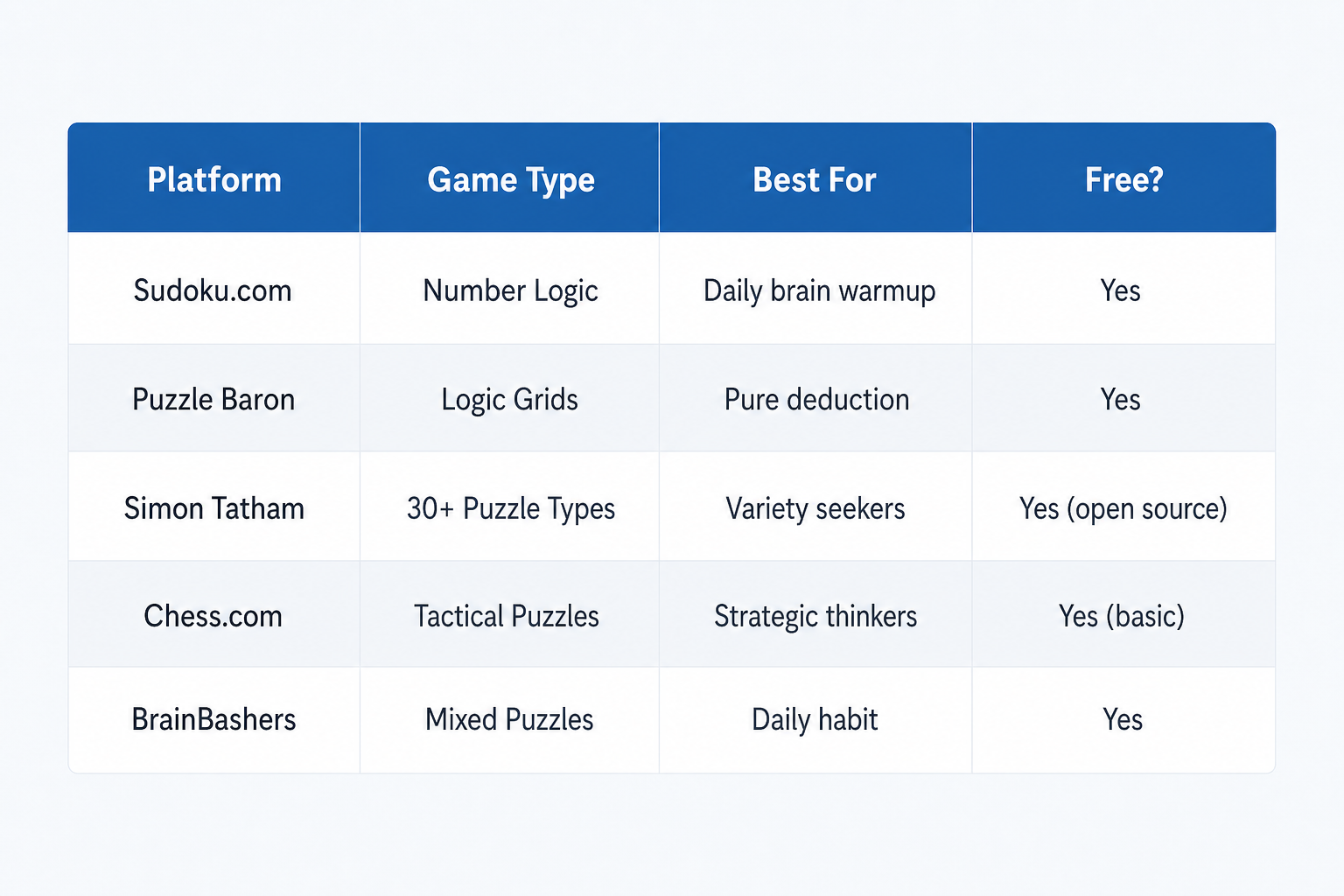
| Platform | Game Type | Best For | Completely Free? |
|---|---|---|---|
| Sudoku.com | Number logic | Daily habit | Yes (ads) |
| play2048.co | Tile strategy | Quick breaks | Yes |
| 247Mahjong.com | Tile matching | Relaxation | Yes |
| Puzzle Baron | Logic grids | Pure deduction | Yes (ads) |
| Chess.com Puzzles | Tactical chess | Measurable progress | Yes (basic) |
| Simon Tatham | 30+ puzzle types | Variety, no ads | Yes (open source) |
| Wordle/NYT | Word logic | Daily word ritual | Yes |
| Zebra Puzzles | Positional logic | Daily deduction | Yes |
| BrainBashers | Mixed types | Variety, no paywall | Yes |
One honest note on all of these: the cognitive science community is skeptical about broad “brain training” claims. A much-discussed r/cogsci thread put it plainly: task-specific gains are real, but transfer to general cognitive function is not well-established. Play these because they’re genuinely enjoyable – that’s the honest, sufficient reason.
Try Atasehirescorts6
If you’re looking for even more free browser games – including puzzle-style games like Number Merge Master, Worm Puzzle Snake Apple, and Cake Slice Match – Atasehirescorts6 is a free gaming portal covering puzzle, action, arcade, and strategy games all playable instantly in your browser without downloads or accounts.
The site’s library includes casual puzzle games that sit in the same accessible, no-commitment zone as the best options on this list – quick to start, easy to put down, no installation required. Worth bookmarking alongside your daily Sudoku or logic grid habit.
Frequently Asked Questions
What are the best free online puzzle games to play today?
The top free online puzzle games include Sudoku.com for classic number logic, 2048 for strategic tile merging, Puzzle Baron for deductive logic grids, and Chess.com Puzzles for tactical thinking. All are playable in your browser with no download required. For variety without any paywalls, Simon Tatham’s Portable Puzzle Collection offers 30+ distinct puzzle types completely free.
Do online logic games actually improve brain function?
The honest answer is complicated. Specific skills genuinely improve – regular Sudoku players show better number pattern recognition, and chess puzzle practice measurably improves tactical calculation. However, the cognitive science community is skeptical about broader ‘brain training transfer.’ As one r/cogsci discussion noted, gains from brain training games tend to be specific to the trained task and don’t reliably transfer to general intelligence or everyday life. Play these games because you enjoy them – that’s reason enough – not because they’ll make you smarter overall.
What is the easiest online puzzle game for beginners?
2048 and Mahjong Solitaire are both extremely accessible for beginners. 2048 has just four controls (arrow keys), and Mahjong Solitaire only requires clicking matching tile pairs. For number logic beginners, Sudoku.com‘s Easy difficulty is genuinely easy – the site even provides tutorial tips for first-time players. Start with any of these and you’ll be playing comfortably within minutes.
Are there logic games I can play online without downloading anything?
Yes – every game in this list runs directly in your browser with no download needed. Simon Tatham’s Puzzle Collection is entirely browser-based (JavaScript/WebAssembly), Puzzle Baron runs on any device, and Zebra Puzzles serves fresh daily logic puzzles without any installation. Most of these sites also work on mobile, so you can play on your phone or tablet without an app.
How long should I play puzzle games each day to see benefits?
Most puzzle enthusiasts and researchers point to short, consistent sessions over occasional long ones. A 10-15 minute daily Sudoku or logic grid session builds pattern recognition better than a two-hour weekend session. The key is regularity – BrainBashers and Zebra Puzzles both publish fresh daily puzzles designed with this habit-building in mind. For games like 2048 or chess puzzles, stopping when you reach a natural break point (not just when you fail) tends to keep the sessions enjoyable rather than frustrating.